Honest Talk: What's Really Flowing Through Your Faucet (And Which Fixes Are Worth It)
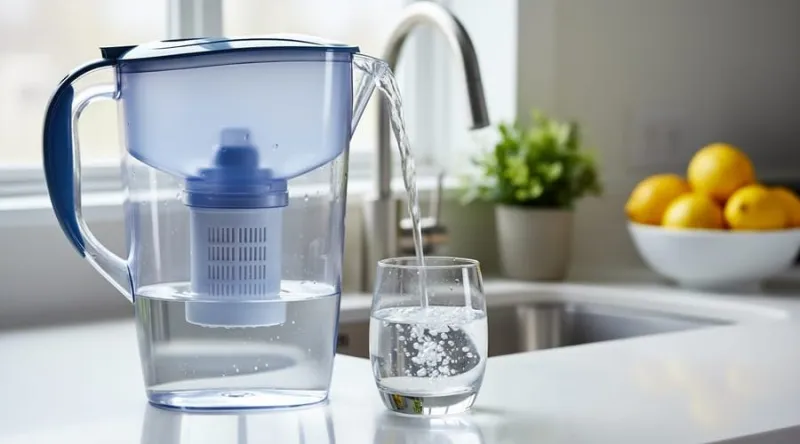
Photo: kitchen faucet pouring clean water into glass with water filter pitcher, via jugfree.com
Let's be honest: most of us have a complicated relationship with tap water. We grew up drinking it, then read a headline about PFAS or lead, bought a pitcher, and quietly hoped for the best. That's not a strategy—it's a shrug. Here's a better one, and it starts with a document most people have never opened.
Start With Your Consumer Confidence Report
By federal law, every community water system in the US publishes an annual Consumer Confidence Report (CCR)—basically a report card for your water utility. Search "[your city] water quality report" or check the EPA's CCR website, and you'll find levels for lead, chlorine byproducts, nitrates, and more, compared against EPA limits.
A few things to know while reading:
- "Below the legal limit" isn't the same as "zero." Limits are compromises between health goals and treatment costs.
- Your report reflects water at the treatment plant. If your home has older plumbing—think pre-1986, when lead solder was banned—your faucet water can differ from the city's numbers.
- Private well? No CCR for you. Wells aren't federally regulated, so testing falls entirely on the homeowner, ideally annually.
Test Kits: Cheap Insurance, With Caveats
For $20–$50, at-home test strips can screen for pH, hardness, chlorine, and some heavy metals. They're decent for ballpark answers. If you have real reason to worry—an old house, a strange taste, a nearby industrial site—a lab-certified test (often $100–$300 through state-certified labs) gives you data you can actually act on. Think of the cheap strips as a smoke detector and the lab test as the fire inspector.
The DIY Options, Ranked Honestly
Activated carbon pitcher filters (the classic Brita-style). Genuinely good at improving taste and cutting chlorine and some disinfection byproducts. Many are now certified to reduce lead, too—check for NSF/ANSI 53 certification on the box, because not all pitchers are equal. Downside: filters need replacing on schedule, and expired filters can do more harm than good by harboring bacteria.
Faucet-mounted and countertop filters. A step up in capacity and often certification coverage. If lead is your concern, look specifically for NSF/ANSI 53 and 42 certifications. These are the sweet spot for most renters and small households.
Reverse osmosis under-sink systems. The heavyweight of DIY-friendly filtration—RO strips out lead, arsenic, nitrates, fluoride, and a meaningful chunk of PFAS. Costlier ($150–$500 plus filter changes) and it wastes some water in the process, but if your lab results show real contamination, this is the home-install answer.
Whole-home filtration. Here's my honest take: for most families, it's overkill. Where it earns its price tag ($1,000+) is when you have hard water wrecking appliances, high sediment, or contaminated water you're also bathing and cooking in. Filtering water you only drink? A $100 setup handles that.
One Thing People Get Wrong
Boiling water removes exactly none of the contaminants people worry about most—lead, nitrates, and PFAS don't evaporate. In fact, boiling slightly concentrates them. Boiling is for microbes, not chemicals.
The Bottom Line
Read your CCR once—it takes ten minutes and replaces vague anxiety with actual numbers. Test if your plumbing is old or you're on a well. Then match the fix to the problem: a certified pitcher for taste and chlorine, an under-sink RO system for serious contaminants, and skip the whole-home system unless you truly need it. Clean water shouldn't require a chemistry degree—just one evening of homework and a filter that's actually certified for what's in your pipes.